

Introduction to Physical Property
A physical property is an important scientific concept that helps us describe, measure, compare, and identify different types of matter. Everything around us, including water, air, metals, wood, plastic, food, and many other materials, has physical characteristics. These characteristics help scientists understand how substances behave under different conditions and determine which materials are suitable for particular purposes.
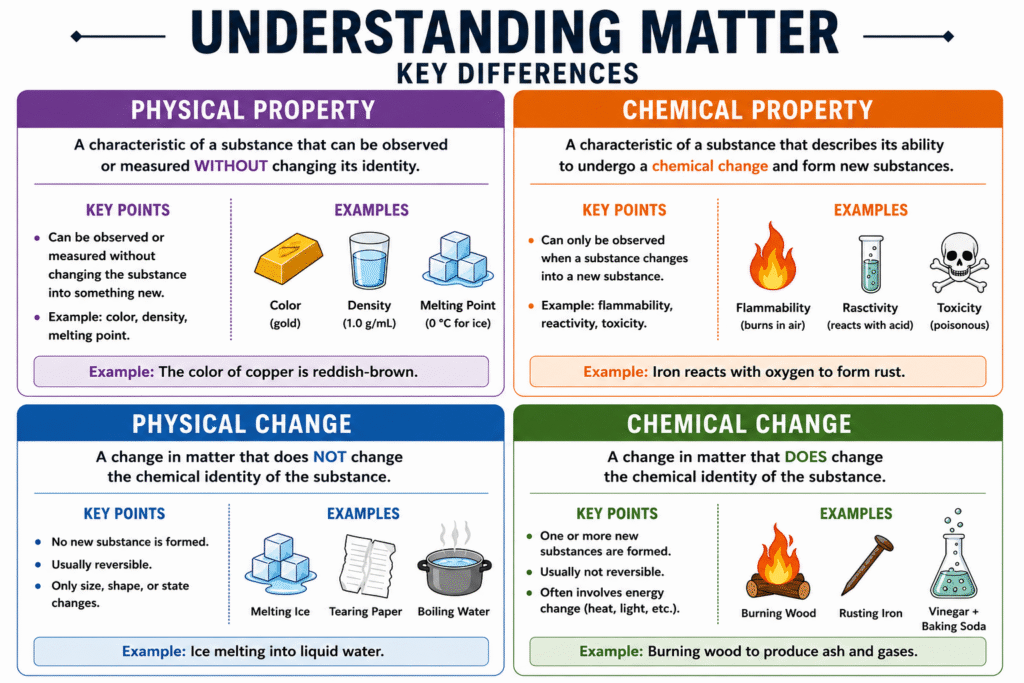
A physical property is a characteristic of matter that can be observed or measured without changing the substance’s chemical identity. Common examples include color, mass, volume, density, melting point, boiling point, hardness, solubility, viscosity, and electrical conductivity.
Physical properties are important in chemistry, physics, engineering, materials science, and everyday life. For example, engineers consider the strength and density of materials when designing buildings. Manufacturers examine thermal conductivity when selecting insulation, while scientists may measure density and melting point to help identify an unknown substance.
Understanding physical properties also helps explain the difference between physical changes and chemical changes. When ice melts into liquid water, its physical state changes, but its chemical identity remains H₂O. In contrast, when iron reacts with oxygen and moisture to form rust, a chemical reaction produces new substances.
This guide explains the definition of a physical property, its main types, important examples, measurement methods, differences from chemical properties, and practical applications in everyday life.
What Is a Physical Property?
A physical property is a characteristic of a substance or object that can be observed or measured without changing its chemical composition. It describes how matter looks, feels, or behaves physically, or how it responds to conditions such as temperature, pressure, and electrical or magnetic fields.
Examples of physical properties include color, mass, volume, density, melting point, boiling point, hardness, solubility, and electrical conductivity.
For example, water is normally a liquid at room temperature and ordinary atmospheric pressure. Its density and boiling point can be measured without changing its chemical identity. When water freezes, it becomes ice, but it remains the same chemical substance.
Physical properties can be classified in different ways. Some are intensive, meaning they do not depend on the total amount of material. Others are extensive, meaning they depend on the amount present. Properties can also be described as qualitative or quantitative, depending on how they are observed and expressed.
Scientists use physical properties to compare materials, identify unknown samples, study matter, and determine whether a material is suitable for a particular application.
Definition of Physical Property in Simple Words
In simple words, a physical property is something about a material that we can observe or measure without turning it into a different chemical substance.
For example, the color of gold, the mass of a book, the volume of water, and the hardness of a diamond are physical properties. Measuring these characteristics does not, by itself, change the chemical identity of the material.
How Physical Properties Are Observed and Measured
Physical properties can be studied through direct observation, scientific instruments, and controlled experiments. Some characteristics, such as color and shape, are easy to observe. Others, including density, electrical conductivity, and thermal conductivity, require measurements.
A balance measures mass, while a graduated cylinder can measure the volume of a liquid. A thermometer measures temperature, and specialized equipment can determine hardness, conductivity, and other material characteristics.
Accurate measurements are important because physical properties may vary with temperature, pressure, composition, and the structure of a material. Scientists therefore use appropriate instruments, standardized units, and controlled conditions to obtain reliable results.
Types of Physical Properties
Physical properties can be classified according to whether they depend on the amount of matter, how they are observed, or the type of physical behavior they describe.
The two main types based on the amount of matter are intensive and extensive properties. Qualitative and quantitative properties describe whether characteristics are expressed through observations or numerical measurements.
1. Intensive Physical Properties
Intensive properties do not depend on the total amount of a substance. They generally remain the same when a uniform sample is divided into smaller portions, provided that the material’s composition and relevant conditions remain unchanged.
Common examples include density, color, melting point, boiling point, electrical conductivity, thermal conductivity, hardness, and refractive index.
For example, a small piece of pure copper and a large piece of the same copper have approximately the same density under the same conditions. The larger piece contains more copper, but its density does not increase simply because the sample is larger.
Intensive properties are useful for comparing and identifying substances. A characteristic density or melting point can help distinguish one material from another, although several properties may be needed to identify an unknown sample confidently.
Important examples of intensive properties include:
- Density
- Melting point
- Boiling point
- Color
- Electrical conductivity
- Thermal conductivity
- Hardness
- Refractive index
- Viscosity
- Temperature
Some intensive properties depend on temperature, pressure, or composition. Therefore, scientific comparisons should account for the conditions under which measurements are taken.
2. Extensive Physical Properties
Extensive properties depend on the amount of matter present. When a uniform sample is divided into smaller portions, its total extensive properties generally divide according to the size of each portion.
Mass and volume are common examples. Total internal energy, total enthalpy, and total entropy are also extensive properties in thermodynamics.
For example, two liters of water have twice the volume of one liter of water. Similarly, dividing a uniform sample into two equal portions produces two portions with approximately half the original mass.
Extensive properties are important in laboratory calculations, industrial manufacturing, transportation, and the design of storage systems.
Common examples include:
- Mass
- Volume
- Total internal energy
- Total enthalpy
- Total entropy
The distinction between intensive and extensive properties helps scientists describe materials accurately and understand how their characteristics relate to sample size.
3. Qualitative Physical Properties
Qualitative properties are characteristics described through observation rather than numerical measurement. They help people recognize differences between materials without assigning a specific numerical value.
Color, texture, visible appearance, transparency, and physical state are common examples.
For instance, a material may be described as silver-colored, rough, transparent, or solid. These descriptions provide useful information even when no numerical measurements are recorded.
However, qualitative observations can be subjective. One person may describe a surface as slightly rough, while another may call it moderately rough. Standardized descriptions and appropriate testing methods can reduce this uncertainty.
Qualitative physical properties are often the starting point of scientific investigations. Researchers may first examine a sample’s appearance before performing more detailed tests.
4. Quantitative Physical Properties
Quantitative properties are expressed through numerical measurements and appropriate units. They allow scientists to compare materials precisely and communicate results clearly.
For example, a sample may have a mass of 50 grams, a volume of 20 cubic centimeters, or a temperature of 30°C.
Density is a quantitative physical property calculated by dividing mass by volume.
Density = Mass ÷ Volume
If a sample has a mass of 60 grams and a volume of 20 cubic centimeters, its density is:
Density = 60 g ÷ 20 cm³ = 3 g/cm³
Quantitative properties are essential in laboratory experiments, engineering calculations, scientific research, and quality control. They help researchers determine whether a material meets specific performance requirements.
Examples of Physical Properties
Physical properties describe different aspects of matter, including its appearance, dimensions, behavior, and response to heat, electricity, pressure, and other physical influences.
1. Color
Color is an observable physical property that helps distinguish one material from another. Gold is typically yellow, sulfur is often yellow, and pure copper has a characteristic reddish-orange appearance.
Color results from how a material interacts with visible light, including the wavelengths it absorbs, reflects, or transmits.
Although color can help identify a substance, it is not always sufficient to determine its identity. Impurities, surface conditions, lighting, and other factors can affect how a sample appears.
2. Mass
Mass measures the inertia of an object and is commonly introduced as the amount of matter it contains. It is usually measured in grams or kilograms using a balance.
For example, a textbook might have a mass of 800 grams, while a small stone might have a mass of 100 grams.
Mass is an extensive physical property because the total mass depends on the amount of material present. It should not be confused with weight, which is the gravitational force acting on an object and depends on the local gravitational field.
Mass measurements are useful in scientific experiments, food preparation, manufacturing, and the calculation of other physical properties.
3. Volume
Volume is the amount of three-dimensional space occupied by an object or substance. It is commonly measured in liters, milliliters, cubic centimeters, or cubic meters.
Liquids can be measured using graduated cylinders or suitable measuring containers. The volume of a regular solid can often be calculated from its dimensions, while the volume of an irregular solid can be determined using liquid displacement when appropriate.
Volume is an extensive property. When the amount of a uniform material increases under comparable conditions, its total volume generally increases as well.
4. Density
Density is the mass of a substance per unit volume. It is a particularly useful physical property because it connects two measurable characteristics.
The formula is:
Density = Mass ÷ Volume
For example, if a solid has a mass of 100 grams and a volume of 25 cubic centimeters, its density is 4 g/cm³.
Density helps explain why some materials float or sink in particular liquids. An object generally floats when its average density is lower than that of the surrounding liquid, assuming ordinary floating conditions and no other significant effects.
Density is used in chemistry, geology, engineering, food production, and material identification. For accurate comparisons, scientists consider temperature, pressure, and the composition of the sample.
5. Melting Point
The melting point is the temperature at which a solid changes into a liquid under specified pressure conditions.
For example, pure ice melts at approximately 0°C, or 32°F, at standard atmospheric pressure. The melting point of a pure crystalline substance can help scientists identify materials and assess their purity.
A sample containing impurities may melt over a range of temperatures rather than at one sharp temperature. Some materials also undergo complex transitions instead of melting in the ordinary way.
Melting point is important in manufacturing, metallurgy, food processing, and laboratory chemistry because it helps determine how materials respond to heat.
6. Boiling Point
The boiling point is the temperature at which a liquid’s vapor pressure equals the surrounding pressure, allowing vapor bubbles to form throughout the liquid.
Pure water boils at approximately 100°C, or 212°F, at standard atmospheric pressure. At higher elevations, where atmospheric pressure is lower, water generally boils at a lower temperature.
Boiling point is useful in distillation, chemical processing, cooking, and substance identification. It also helps engineers select appropriate operating temperatures for industrial systems.
Because boiling point depends on pressure, measurements should be interpreted in relation to the surrounding conditions.
7. Solubility
Solubility describes the amount of a substance that can dissolve in another substance under specified conditions. The substance being dissolved is called the solute, while the substance doing the dissolving is called the solvent.
For example, sugar dissolves in water to form a solution under ordinary conditions. Sand, by contrast, does not dissolve appreciably in water under the same conditions.
Solubility depends on the substances involved and may vary with temperature and pressure. For many solid solutes, increasing temperature increases solubility, although there are exceptions. The solubility of many gases in liquids decreases as temperature rises.
Solubility is important in medicine, food production, environmental science, and chemical manufacturing. It is generally treated as a physical property when dissolution occurs without changing the chemical identity of the substances.
8. Hardness
Hardness describes a material’s resistance to scratching, indentation, or localized deformation, depending on the test method used.
Diamond is well known for its high scratch hardness, while softer materials can be scratched more easily. Different scientific tests measure different aspects of hardness, so results must be interpreted according to the method used.
Hardness is important when selecting tools, protective coatings, construction materials, and industrial components.
Hardness is not the same as toughness, which describes resistance to fracture, or strength, which describes resistance to applied forces. A material can be hard but brittle, meaning it may resist scratching yet break when subjected to particular forces.
9. Electrical Conductivity
Electrical conductivity describes how readily a material allows electric current to pass through it.
Copper and aluminum are widely used as electrical conductors because they conduct electricity effectively. Materials such as rubber and glass generally have much lower electrical conductivity under ordinary conditions and are commonly used as electrical insulators.
Conductivity is influenced by temperature, composition, and material structure. It is important in electronics, electrical wiring, power generation, and the design of insulating materials.
Understanding electrical conductivity helps engineers select appropriate materials for circuits, cables, sensors, and electrical equipment.
10. Thermal Conductivity
Thermal conductivity describes a material’s ability to transfer heat through conduction.
Metals such as copper and aluminum generally have high thermal conductivity. Materials such as fiberglass and many types of foam transfer heat less readily and are used for insulation.
This property matters when designing cooking equipment, building insulation, heat exchangers, refrigeration systems, and electronic devices.
Choosing materials with suitable thermal conductivity can improve energy efficiency, temperature control, and equipment performance.
11. Texture
Texture describes the surface characteristics of a material. A surface may feel smooth, rough, grainy, slippery, or coarse.
Texture can be assessed through touch or examined using specialized instruments. In some applications, researchers use standardized surface-roughness measurements to compare materials accurately.
Texture is important in clothing, food, furniture, manufacturing, and product design. For example, the surface texture of a tire affects its interaction with a road, while the texture of bread influences its eating quality.
12. Magnetism
Magnetism describes how a material responds to a magnetic field. Iron, cobalt, and nickel are well-known examples of elements that can exhibit ferromagnetic behavior under suitable conditions.
Materials respond to magnetic fields in different ways. Some are strongly attracted to magnets, while others respond weakly or exhibit different magnetic behavior.
Magnetic properties are useful in motors, generators, electronic devices, magnetic storage systems, and scientific instruments.
13. Viscosity
Viscosity measures a fluid’s resistance to flow. A highly viscous liquid flows less readily than a low-viscosity liquid under comparable conditions.
For example, honey generally flows more slowly than water because it has a higher viscosity at ordinary temperatures.
Viscosity is important in the production of paints, lubricants, medicines, food products, and industrial fluids. Temperature can strongly affect viscosity, especially in liquids, so measurements should be compared under consistent conditions.
14. Physical State
The physical state of matter describes whether a substance exists as a solid, liquid, gas, or another state under specified conditions. Plasma is another state of matter found in environments such as stars and certain electrical discharges.
A solid generally maintains its shape and volume. A liquid maintains a relatively fixed volume but takes the shape of its container. A gas expands to occupy the available space, while plasma consists of ionized particles.
Water provides a familiar example. It can exist as ice, liquid water, or water vapor depending on temperature and pressure. These changes of state are physical changes because the chemical identity of water remains H₂O.
Physical Properties of Solids, Liquids, and Gases
Matter commonly exists as solids, liquids, and gases under everyday conditions. Each state has characteristic physical properties related to particle arrangement, movement, temperature, and pressure.
Physical Properties of Solids
Solids generally have a definite shape and a definite volume. Their particles are held relatively close together and typically vibrate around positions determined by the material’s structure.
Examples include wood, glass, iron, salt crystals, and ice.
Important physical properties of solids include density, hardness, strength, brittleness, elasticity, and thermal conductivity. However, these characteristics vary considerably among different solids.
For example, rubber can deform and return toward its original shape under suitable conditions, while glass is relatively brittle. Metals may be strong and ductile, meaning they can undergo deformation without breaking under appropriate conditions.
Solids are widely used in construction, manufacturing, electronics, furniture, and transportation because their physical properties can be matched to specific applications.
Physical Properties of Liquids
Liquids have a relatively definite volume but take the shape of their containers. Their particles can move past one another, allowing liquids to flow.
Water, cooking oil, milk, and mercury are examples of liquids under ordinary conditions.
Important physical properties of liquids include density, viscosity, surface tension, boiling point, freezing point, and vapor pressure.
For example, oil and water do not mix uniformly under ordinary conditions. Honey has a higher viscosity than water, while water flows more readily at comparable temperatures.
Liquid properties are important in pumping systems, chemical processing, medicine, cooking, and fluid transport.
Physical Properties of Gases
Gases do not have a fixed shape or a fixed volume. They expand to fill their containers and can be compressed much more easily than ordinary liquids and solids.
Air, oxygen, nitrogen, and carbon dioxide are examples of gases under common environmental conditions.
Important physical properties of gases include pressure, temperature, volume, density, and compressibility.
Gas behavior is essential to understanding weather, breathing, combustion, refrigeration, industrial processes, and the operation of engines.
For an ideal gas, pressure, volume, temperature, and the amount of gas are related by the equation:
PV = nRT
In this equation, P represents pressure, V represents volume, n represents the amount of gas in moles, R is the gas constant, and T is absolute temperature in kelvin.
This relationship helps scientists predict how gases behave when temperature, pressure, or volume changes.
Physical Property vs. Chemical Property
Physical properties and chemical properties both describe matter, but they provide different kinds of information.
A physical property can be observed or measured without changing a substance’s chemical identity. A chemical property describes the substance’s ability to undergo a chemical reaction that changes its chemical composition.
For example, the density of copper is a physical property, while its tendency to react with particular chemicals is related to its chemical properties.
Key Differences Between Physical and Chemical Properties
| Feature | Physical Property | Chemical Property |
| Meaning | Describes physical characteristics of matter | Describes the ability to undergo chemical reactions |
| Chemical identity | Can be measured without changing chemical identity | Concerns behavior that can produce new substances |
| Examples | Density, color, volume, melting point | Flammability, oxidation tendency, chemical reactivity |
| Observation | Often measured directly | Often demonstrated through chemical reactions |
| Practical use | Identifying and selecting materials | Predicting chemical behavior and stability |
Examples of Physical Properties
Common examples include:
- Water is colorless in small, pure samples under ordinary viewing conditions.
- Copper conducts electricity.
- Ice melts at approximately 0°C under standard atmospheric pressure.
- A metal sample has a measurable density.
- Glass is generally transparent to visible light.
These observations do not, by themselves, change the chemical identity of the materials.
Examples of Chemical Properties
Chemical properties include flammability, the tendency to oxidize, and reactivity with acids or other substances.
For example, iron can react with oxygen and moisture under suitable conditions to form rust. Its tendency to undergo this reaction is a chemical property.
Wood’s ability to burn is another example. Combustion produces new substances, including gases and solid residues, through chemical reactions.
Understanding both types of properties is important because materials must often meet physical performance requirements while also providing appropriate chemical stability.
Physical Properties vs. Physical Changes
A physical property describes a characteristic of matter, while a physical change describes a process in which matter changes its physical form without changing its chemical identity.
For example, melting point is a physical property. Melting ice is a physical change. These concepts are related but are not interchangeable.
What Is a Physical Change?
A physical change occurs when the size, shape, state, or other physical characteristics of a substance change without producing a different chemical substance.
Common examples include melting, freezing, evaporation, condensation, cutting, crushing, and dissolving certain substances.
When ice melts, solid water becomes liquid water. When water freezes, liquid water becomes solid ice. Both processes preserve the chemical identity of H₂O.
Similarly, cutting a sheet of aluminum into smaller pieces changes its size and shape but does not ordinarily change its chemical composition.
Common Examples of Physical Changes
Melting ice: Ice absorbs heat and becomes liquid water.
Freezing water: Liquid water loses heat and forms ice.
Evaporation: Liquid water changes into water vapor.
Condensation: Water vapor changes into liquid water.
Cutting paper: The paper changes size and shape without necessarily undergoing a chemical reaction.
Dissolving sugar: Sugar molecules disperse through water while retaining their chemical identity under ordinary conditions. Sugar can often be recovered by evaporating the water.
These examples demonstrate how physical properties and physical changes help explain the behavior of matter.
How Are Physical Properties Measured?
Scientific measurement makes it possible to describe physical properties accurately and compare results across experiments.
Different properties require different instruments and methods. Measurements should use appropriate units and account for conditions that may affect the result.
Measuring Mass and Volume
Mass is commonly measured using a balance. Depending on the instrument and experiment, measurements may be recorded in grams or kilograms.
Volume is measured in liters, milliliters, cubic centimeters, or cubic meters. A graduated cylinder is commonly used for liquids, while geometric calculations can determine the volume of regular solid objects.
For irregular solids, liquid displacement can be used when the material does not dissolve, react with, or absorb the measuring liquid in a way that significantly affects the result.
Measuring Density and Temperature
Density is calculated by dividing mass by volume. Scientists may use grams per cubic centimeter or kilograms per cubic meter, depending on the application.
Temperature can be measured using thermometers or electronic temperature sensors. Depending on the scientific context, temperature may be recorded in degrees Celsius, degrees Fahrenheit, or kelvin.
When determining melting points or boiling points, researchers must consider pressure and sample purity because these factors can affect measured values.
Common Scientific Tools and Units
| Property | Common Instrument or Method | Typical Units |
| Mass | Balance | Gram (g), kilogram (kg) |
| Volume | Graduated cylinder or geometric calculation | mL, L, cm³, m³ |
| Temperature | Thermometer or temperature sensor | °C, °F, K |
| Density | Mass divided by volume | g/cm³, kg/m³ |
| Length | Ruler or caliper | mm, cm, m |
| Electrical conductivity | Conductivity meter or electrical testing equipment | S/m |
| Pressure | Pressure gauge or sensor | Pa, kPa, bar |
| Hardness | Appropriate standardized hardness test | Depends on the test scale |
Accurate measurement helps scientists distinguish between materials and evaluate whether a sample meets a particular standard. Repeated measurements, instrument calibration, and controlled experimental conditions improve reliability.
Importance of Physical Properties in Everyday Life
Physical properties are not limited to school science experiments. They influence how materials are selected, how products are designed, and how everyday objects function.
Physical Properties in Science and Education
Students learn about physical properties to understand matter, develop observation skills, and conduct scientific experiments.
For example, comparing the densities of different liquids helps explain why they may form separate layers. Measuring the melting point of a substance can demonstrate changes of state.
Physical properties also support advanced subjects, including chemistry, physics, geology, environmental science, and materials science.
Physical Properties in Manufacturing and Industry
Manufacturers consider physical properties when choosing raw materials and designing products.
Electrical wires commonly use conductive metals such as copper or aluminum. Buildings use materials selected for properties such as strength, durability, thermal performance, and resistance to environmental conditions.
The food industry considers texture, viscosity, density, and melting behavior during processing. Pharmaceutical manufacturers may evaluate solubility, particle size, and melting characteristics when developing products.
In each case, the selected properties must suit the intended purpose and applicable safety standards.
Physical Properties in Construction
Construction materials must meet requirements for strength, density, hardness, thermal conductivity, and durability.
Concrete, steel, glass, wood, and insulation materials have different characteristics. Engineers use these differences when selecting materials for foundations, structural components, windows, roofing, and interior systems.
For example, low thermal conductivity can be useful in insulation, while high strength may be essential for load-bearing structures.
Physical properties alone do not determine whether a material is suitable. Engineers also consider chemical durability, fire behavior, cost, environmental effects, and relevant building codes.
Physical Properties in Food and Cooking
Physical properties influence how food behaves during preparation and storage.
The viscosity of a sauce affects how easily it pours. The melting point of fats influences their behavior during cooking. The texture of bread, fruit, and other foods contributes to their quality and consumer appeal.
Temperature also changes many physical properties. Butter becomes softer as it warms, while water changes state when it reaches its freezing or boiling conditions.
Understanding these characteristics helps food producers maintain consistent quality and develop appropriate processing methods.
Physical Properties in Technology
Modern technology depends on materials with specific physical characteristics.
Semiconductors are selected for their electrical behavior. Metals are used in electrical conductors, while insulating materials help reduce unwanted current flow. Optical materials are selected for how they transmit, reflect, or refract light.
Thermal conductivity is particularly important in electronic devices because excess heat can reduce performance or damage components.
Material scientists study these properties to improve batteries, sensors, solar panels, computers, communication systems, and other technologies.
Factors That Can Affect Physical Properties
Physical properties characterize particular materials, but measured values do not always remain constant under every condition.
Temperature
Temperature can affect density, viscosity, electrical conductivity, and physical state. Heating a solid may cause it to expand, while heating a liquid can change its viscosity and increase its vapor pressure.
Water, for example, freezes under ordinary atmospheric pressure at approximately 0°C and boils at approximately 100°C.
Pressure
Pressure can influence volume, density, and phase transitions. Gases are particularly compressible, so increasing pressure can significantly reduce their volume under appropriate conditions.
Pressure also affects boiling points. A liquid may boil at a lower temperature when the surrounding pressure is reduced.
Composition and Purity
A material’s composition can influence its melting point, density, conductivity, solubility, and other characteristics.
Pure substances often exhibit characteristic physical properties under defined conditions. Mixtures, alloys, and impure samples may show different values or a range of melting temperatures.
For example, adding a suitable dissolved substance to water can lower its freezing point. The precise effect depends on the substance and its concentration.
Material Structure
The arrangement of atoms, molecules, or other particles can influence hardness, electrical conductivity, strength, and other properties.
Different forms of the same element can have different physical characteristics. Diamond and graphite, for example, are both forms of carbon but differ greatly in hardness and electrical behavior because their atomic structures differ.
These factors explain why scientists must consider experimental conditions when comparing the physical properties of materials.
How Physical Properties Help Identify Substances
Physical properties are valuable for identifying unknown substances because different materials often have different combinations of measurable characteristics.
Scientists may examine color, density, solubility, melting point, boiling point, conductivity, and other properties when studying an unknown sample.
For example, a material’s density can help narrow down possible identities. Its melting point and solubility may provide additional evidence.
However, many substances share similar individual properties. Color alone cannot reliably identify a material, and mixtures may behave differently from pure substances. For this reason, identification often requires several independent tests.
In laboratories, physical measurements may be combined with chemical tests and instrumental techniques to produce a more reliable identification.
This process is important in quality control, forensic analysis, mineral identification, manufacturing, and scientific research.
Frequently Asked Questions About Physical Properties
1. What Is a Physical Property in Simple Words?
A physical property is a characteristic of matter that can be observed or measured without changing its chemical identity. Color, mass, volume, density, and melting point are common examples.
2. What Are Five Examples of Physical Properties?
Five examples are color, density, mass, volume, and melting point. Other examples include boiling point, hardness, solubility, viscosity, and electrical conductivity.
3. What Are the Two Main Types of Physical Properties?
The two main types are intensive and extensive properties. Intensive properties do not depend on the amount of material, while extensive properties depend on the amount present. Density is intensive, whereas mass and volume are extensive.
4. Is Density a Physical Property?
Yes. Density is a physical property because it can be measured without changing a substance’s chemical identity. It is calculated by dividing mass by volume and is generally an intensive property for a uniform material under specified conditions.
5. Is Color a Physical Property?
Yes. Color is a physical property because it can be observed without changing the chemical identity of a substance. However, color may be affected by lighting, impurities, surface conditions, and other factors.
6. Is Mass a Physical Property?
Yes. Mass is an extensive physical property that measures an object’s inertia and is commonly introduced as the amount of matter it contains. It is usually measured in grams or kilograms.
7. What Is the Difference Between Physical and Chemical Properties?
Physical properties describe characteristics that can be observed or measured without changing chemical identity. Chemical properties describe how a substance can undergo chemical reactions. Density is a physical property, while flammability is a chemical property.
8. Can Physical Properties Change?
Yes. A substance’s physical properties can change when conditions such as temperature or pressure change. For example, ice melts into liquid water as it warms. Its physical state changes physical property, but its chemical identity remains H₂O.
9. Is Melting a Physical or Chemical Change?
Melting is a physical change when a substance changes from solid to liquid without a chemical reaction. Ice melting into water is a common example because both forms consist of H₂O.
10. Why Are Physical Properties Important?
Physical properties help scientists identify materials, compare substances, understand physical property matter, and select materials for specific purposes. They are important in education physical property, research, engineering, construction, medicine, food production, and manufacturing.
11. What Is an Example of an Intensive Property?
Density is a common example of an intensive property. A uniform sample of pure copper physical property has approximately the same density regardless of whether the sample is large or small, provided the conditions remain the same.
12. What Is an Example of an Extensive Property?
Mass is an extensive property because it depends on the amount physical property of matter present. If a uniform sample is divided into two equal portions, each portion has approximately half the original mass.
13. Is Solubility a Physical Property?
Solubility is generally treated as a physical property when a substance dissolves without physical property changing its chemical identity. However, some substances react chemically with a solvent, so the details of the system matter.
14. Is Boiling Point a Physical Property?
Yes. Boiling point is a physical property that describes the temperature at which physical property a liquid’s vapor pressure equals the surrounding pressure. It is useful for comparing and identifying substances under defined conditions.
15. What Is the Difference Between Qualitative and Quantitative Physical Properties?
Qualitative properties are described through observations, such as color or texture. Quantitative properties are expressed using numerical measurements, such as a mass of 20 grams or a physical property density of 2 g/cm³.
16. What Is the Difference Between Intensive and Extensive Properties?
Intensive properties do not depend on the total amount of material, while extensive physical property properties do. Density and melting point are intensive properties, whereas mass and volume are extensive properties.
17. How Do Scientists Measure Physical Properties?
Scientists use instruments and standardized methods. Balances measure mass, graduated cylinders measure liquid volume, thermometers measure temperature, and specialized equipment measures physical property conductivity and hardness.
18. Can Physical Properties Help Identify an Unknown Substance?
Yes. Scientists compare properties such as density, melting point, solubility, and conductivity physical property to narrow down possible identities. Multiple tests usually provide stronger evidence than relying on a single property.
Conclusion
A physical property is a characteristic of matter that can be observed or measured physical property without changing its chemical identity. These properties help scientists describe substances, distinguish physical property materials, understand physical changes, and select suitable materials for practical applications.
The main classifications include intensive and extensive properties, while qualitative and quantitative descriptions explain how physical characteristics are observed or measured. Common physical property examples physical property include color, mass, volume, density, melting point, boiling point, solubility, hardness, viscosity, and electrical physical property conductivity.
Physical properties also help explain the behavior of solids, liquids, and gases. Their practical importance extends across chemistry, physics, engineering, manufacturing, construction physical property, food production, and modern technology.
Understanding the difference between physical and chemical properties physical property is equally important. A physical property can be measured without changing chemical identity, whereas physical property a chemical property concerns a substance’s ability to undergo a chemical reaction.
By studying physical properties carefully and measuring them under appropriate physical property conditions, students, researchers, and professionals can better understand matter and make informed decisions about how materials should be identified, evaluated, and used.
In short, physical properties provide essential information about the observable physical property and measurable characteristics of the world around us. They form a foundation for scientific physical property learning and practical problem-solving across many fields.



Pingback: Physical Property Definition: Meaning, Types & best 5