

Introduction
What is a physical property? A physical property is a characteristic of matter that what is a physical property can be observed or measured without changing the substance into a different chemical what is a physical property substance. Physical properties help us describe materials, compare substances, identify what is a physical property unknown samples, and understand how matter behaves under different conditions.
Everything around us has physical characteristics. Water has a measurable what is a physical property density and boiling point, copper has a reddish-brown color and high electrical conductivity what is a physical property, and glass is transparent under ordinary conditions. These characteristics help scientists and students what is a physical property understand the differences between materials without needing to change their chemical identities.
Physical properties are important in chemistry, physics, engineering, manufacturing, what is a physical property medicine, environmental science, and everyday life. They help engineers select suitable what is a physical property construction materials, manufacturers maintain product quality, and scientists investigate what is a physical property the composition and behavior of matter.
For example, measuring the mass of a book does not change the material from which it is made what is a physical property. Similarly, observing the color of a mineral or measuring the melting point of ice does not what is a physical property require a chemical reaction. These are examples of how physical properties can be examined.
This guide explains the physical property definition, different types of physical properties, common what is a physical property examples, measurement methods, and the differences between physical and chemical what is a physical property properties. It also answers frequently asked questions to make the topic easier to what is a physical property understand.
What Is a Physical Property?
A physical property is a characteristic of a substance or material that can be observed or what is a physical property measured without changing its chemical identity.
Physical properties describe how matter looks, feels, measures, or responds to physical conditions. Common examples include color, mass, volume, density, hardness, texture, solubility, melting point, boiling point, and electrical conductivity.
Consider ice as an example. When ice melts, it changes from a solid into liquid water. However what is a physical property, both ice and liquid water consist of H₂O molecules. The change in physical state does not create a different chemical substance, so melting point is a physical property of water.
Copper provides another example. Its reddish-brown appearance and ability to conduct electricity are physical properties. Scientists can observe its color and measure its electrical conductivity what is a physical property without needing to transform copper into another chemical substance.
Physical properties are commonly divided into two categories: qualitative and what what is a physical property is a physical property quantitative.
- Qualitative properties: Characteristics described through observation what is a physical property rather what is a physical property than numerical measurements, such as color, texture what is a physical property, and transparency.
- Quantitative properties: Characteristics measured numerically, such as mass, what is a physical property volume, density, and temperature.
In simple words, a physical property tells us something about the characteristics of what is a physical property matter without requiring a chemical transformation.
Physical Property Definition in Science
In science, a physical property is a measurable or observable characteristic of a what is a physical property material that can be examined without changing its chemical identity.
This definition has two important parts.
First, a physical property provides information about a substance or object. what is a physical property Scientists can examine its appearance, measure its density, test its hardness, or determine how what is a physical property effectively it conducts heat or electricity.
Second, measuring a physical property does not require the material to become what is a physical property a different chemical substance. For example, determining the temperature of water or measuring what is a physical property the volume of a liquid does not normally change its chemical what is a physical property composition.
Physical properties can help distinguish between different substances what is a physical property. Gold and aluminum both have metallic appearances, but they differ in density, color, hardness what is a physical property, and other characteristics. Scientists can use these differences to compare materials and investigate their what is what is a physical property a physical property identities.
However, a single physical property does not always provide enough information what is a physical property to identify an unknown substance. Different materials may have similar colors, densities what is a physical property, or other characteristics. Reliable identification often requires several measurements and what is a physical property, when necessary, additional chemical analysis.
Physical properties can also depend on environmental conditions. Temperature what is a physical property and pressure can influence density, volume, melting point, and boiling point. For what is a physical property accurate scientific comparisons, measurements should be made under known and appropriate what is a physical property conditions.
Key Characteristics of Physical Properties
Physical properties have several characteristics that make them useful in science and what is a physical property practical applications.
1. They Can Be Observed or Measured
Some physical properties can be observed directly. Examples include color, shape what is a physical property, texture, transparency, and luster.
Other properties require instruments or calculations. A balance measures mass what is a physical property, a thermometer measures temperature, and density can be calculated from mass and volume.
2. They Do Not Require a Change in Chemical Identity
A physical property can be examined without transforming a substance into a different what is a physical property chemical substance.
For example, cutting a piece of copper changes its size and shape, but the copper remains copper what is a physical property. The change affects the object’s physical characteristics rather than its chemical identity.
3. They Help Describe and Compare Materials
Physical properties provide useful information about the differences between materials.
For example, density can help distinguish between substances with similar appearances what is a physical property. Electrical conductivity helps engineers select materials for wiring, while hardness helps manufacturers choose materials for tools and equipment.
4. They Can Be Qualitative or Quantitative
Qualitative properties are described through observations, such as a material being shiny, what is a physical property rough, or transparent.
Quantitative properties are expressed using measurements, such as a mass of 50 grams what is a physical property, a volume of 20 milliliters, or a temperature of 25°C.
5. They Can Depend on Conditions
Some physical properties change when temperature, pressure, or other conditions what is a physical property change.
For example, many materials expand when heated, and the density of a gas can change what is a physical property what is a physical property considerably with temperature and pressure. Water also changes its physical state when it freezes or boils under suitable conditions.
These changes do not automatically mean that the substance has undergone a chemical what is a physical property reaction.
Types of Physical Properties
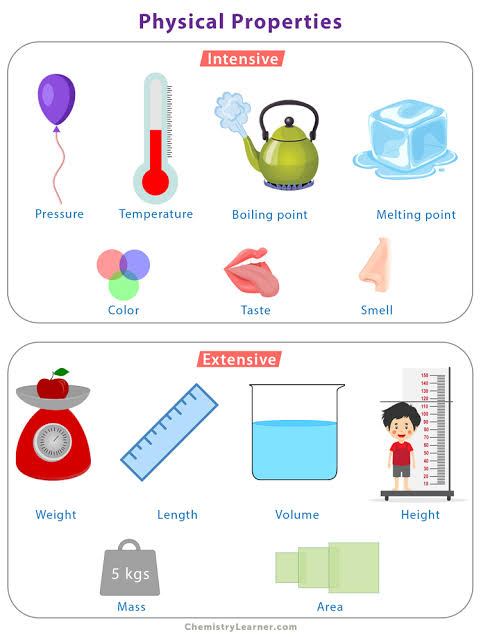
Physical properties can be classified in several ways. One important classification distinguishes what is a physical property intensive properties from extensive properties. Other useful classifications distinguish qualitative from quantitative properties and observable from instrument-measured characteristics.
1. Intensive Properties
An intensive property does not depend on the amount of material present, assuming comparable what is a physical property conditions and a uniform sample.
Examples include density, melting point, boiling point, color, refractive index, and electrical conductivity.
For example, a small piece of pure copper and a larger piece of the same pure copper generally what is a physical property have the same density when measured at the same temperature and pressure. The larger piece contains more copper, but its density does not increase simply because the sample is larger.
Intensive properties are useful for comparing and identifying substances because their values what is a physical property do not normally depend on sample size.
Common examples of intensive properties include:
- Density
- Color
- Melting point
- Boiling point
- Temperature
- Refractive index
- Electrical conductivity
- Specific heat capacity
- Hardness, when measured using the same test method
Some intensive properties vary with temperature, pressure, purity, or the material’s structure. Therefore, measurement conditions remain important when accuracy is required.
2. Extensive Properties
An extensive property depends on the amount of material present.
Mass and volume are common examples. If a uniform sample is divided into smaller pieces, each piece has less mass and volume than the original sample, assuming no material is lost.
For example, one liter of water contains more water than half a liter. Under comparable conditions, the larger quantity has greater mass and volume.
Other extensive properties include total energy, total electric charge, and the amount of substance.
Extensive properties help scientists determine how much material is present and calculate the resources required for a process.
Common examples include:
- Mass
- Volume
- Total energy
- Total electric charge
- Amount of substance
The distinction between intensive and extensive properties is important because it explains why some characteristics remain the same when a sample is divided while others change.
3. Qualitative Physical Properties
Qualitative physical properties are described through observation rather than numerical measurements.
Examples include color, texture, transparency, luster, and the general appearance of a material.
A glass window is transparent, a piece of sandpaper feels rough, and a polished metal surface may appear shiny. These observations describe physical characteristics.
However, qualitative observations may depend on lighting, surface condition, or the observer. Standardized methods can improve consistency when scientists compare materials.
4. Quantitative Physical Properties
Quantitative physical properties are expressed using numerical measurements and appropriate units.
Examples include mass, volume, density, temperature, melting point, and electrical resistance.
A laboratory balance can measure mass in grams, a thermometer can measure temperature in degrees Celsius, and a graduated cylinder can measure liquid volume in milliliters.
Quantitative measurements allow scientists to record results, compare samples, identify patterns, and communicate findings more precisely.
Examples of Physical Properties
Physical properties occur in nearly every material we encounter. The following examples explain common properties and their practical uses.
1. Color
Color describes how a material appears under particular lighting conditions.
Copper commonly has a reddish-brown appearance, sulfur is often yellow, and pure water appears colorless in small quantities.
Color is a useful physical property in mineral identification, food inspection, product design, and manufacturing. However, it is not always sufficient to identify a substance because different materials can have similar colors.
Impurities, coatings, surface conditions, and lighting can also affect a material’s appearance.
2. Mass
Mass measures the amount of matter in an object. It is commonly expressed in grams or kilograms.
For example, a textbook might have a mass of 800 grams, while a small coin might have a mass of only a few grams.
Mass is an extensive physical property because it depends on the amount of material present. If an object is divided into smaller pieces, the mass of each piece will be lower than the original mass if the pieces contain only part of the original material.
Mass should not be confused with weight. Mass measures the amount of matter, while weight is the gravitational force acting on an object. An object’s mass remains approximately constant when it moves from Earth to the Moon, but its weight changes because gravitational acceleration differs.
3. Volume
Volume is the amount of three-dimensional space occupied by a substance or object.
It is commonly measured in liters, milliliters, cubic centimeters, and cubic meters.
For example, a bottle may contain 500 milliliters of water, while a storage container may have a volume of 10 liters.
Volume is an extensive property because the total volume generally increases when more of the same material is added under comparable conditions.
Scientists use volume measurements to prepare solutions, measure liquids, design containers, and calculate density.
4. Density
Density describes how much mass is contained within a given volume. It is one of the most useful physical properties for comparing materials.
The formula for density is:
Density = Mass ÷ Volume
In mathematical notation:
ρ = m / V
Here, ρ represents density, m represents mass, and V represents volume.
For example, suppose an object has a mass of 100 grams and a volume of 20 cubic centimeters.
Density = 100 ÷ 20
Density = 5 g/cm³
Therefore, the object’s density is 5 grams per cubic centimeter.
Density is an intensive property for a uniform material under specified conditions. A larger sample of the same material has more mass and volume, but its density generally remains the same.
Density also helps explain floating and sinking. An object can float when its average density is lower than the density of the surrounding liquid and the relevant buoyancy conditions are satisfied. A hollow metal boat, for example, can float even though the metal itself is denser than water because the boat’s overall average density includes the air-filled space inside it.
Temperature and pressure can affect density, particularly in gases, so these conditions should be considered when comparing measurements.
5. Melting Point
The melting point is the temperature at which a solid changes into a liquid under specified pressure conditions.
Pure ice melts at approximately 0°C or 32°F at standard atmospheric pressure.
Melting point is a physical property because the change from solid to liquid does not normally alter the chemical identity of the substance.
Scientists use melting points to help identify pure substances, assess material quality, and select materials for manufacturing.
Pure substances often have characteristic melting points under specified conditions, while mixtures may melt over a range of temperatures. Impurities can also affect melting behavior.
6. Boiling Point
The boiling point is the temperature at which a liquid’s vapor pressure equals the surrounding pressure, allowing vapor bubbles to form throughout the liquid.
Pure water boils at approximately 100°C or 212°F at standard atmospheric pressure.
Boiling point depends on pressure. At higher elevations, atmospheric pressure is generally lower, so water usually boils at a lower temperature.
Boiling point is an intensive physical property under specified conditions. It is important in cooking, distillation, chemical processing, and scientific identification.
7. Solubility
Solubility describes how much of a substance can dissolve in a particular solvent under specified conditions.
For example, table sugar dissolves in water, while many oils do not mix uniformly with water.
Solubility depends on the substances involved, temperature, pressure in relevant systems, and the composition of the solution. Increasing temperature increases the solubility of many solids in water, although this is not true for every substance.
Solubility is generally treated as a physical property when dissolving does not change the chemical identity of the substance. However, some materials react chemically with a solvent, so not every process that appears to be dissolving is purely physical.
Solubility measurements are useful in medicine, food production, environmental science, and laboratory chemistry.
8. Hardness
Hardness describes a material’s resistance to scratching, indentation, or localized deformation, depending on the testing method.
Diamond is extremely hard on the Mohs mineral hardness scale, while talc is the softest reference mineral on that scale.
Hardness is important in construction, jewelry, manufacturing, and tool design. Engineers select materials with suitable hardness for applications involving friction, pressure, and wear.
Different hardness tests measure different aspects of material behavior, so results must be interpreted according to the test used.
9. Electrical Conductivity
Electrical conductivity describes how easily a material allows electric current to flow.
Copper and aluminum are good electrical conductors, which makes them useful in wiring and power systems. Rubber and glass generally act as electrical insulators under ordinary conditions.
Electrical conductivity is a physical property because it can be measured without requiring the material to become a different chemical substance.
This property is important in electrical engineering, electronics, power distribution, and the development of insulating materials.
10. Thermal Conductivity
Thermal conductivity describes how effectively a material transfers heat through itself.
Copper and aluminum generally conduct heat well. Materials such as fiberglass and many foams transfer heat less effectively and are commonly used for insulation.
Thermal conductivity helps engineers select materials for cookware, buildings, refrigeration systems, and industrial equipment.
11. Texture
Texture describes the surface characteristics of a material, including whether it feels smooth, rough, grainy, or slippery.
A polished stone may feel smooth, while untreated wood may feel rough. Sandpaper has a rough surface that helps it remove material from other surfaces.
Texture can be evaluated through touch, visual inspection, or specialized equipment. It is useful in manufacturing, product design, food science, and material testing.
Texture usually describes the surface or form of a particular object rather than an intrinsic property that remains identical in every sample of a material.
12. Magnetism
Magnetism describes how a material responds to magnetic fields.
Iron, nickel, and cobalt are familiar examples of materials that can exhibit strong magnetic behavior under suitable conditions. Other materials respond more weakly to magnetic fields.
Magnetic properties are important in electric motors, generators, electronic devices, medical imaging equipment, and material identification.
Measuring magnetic behavior does not necessarily change a material’s chemical identity, making magnetism a physical property.
Physical Properties of Solids, Liquids, and Gases
Matter commonly exists as a solid, liquid, or gas under familiar conditions. Each state has characteristic physical properties related to the arrangement and movement of its particles.
Physical Properties of Solids
Solids generally have a definite shape and volume. Their particles are closely packed compared with those in gases, although their arrangement differs between crystalline and amorphous solids.
Examples include ice, wood, metals, glass, and rocks.
Common physical properties of solids include:
- Shape and volume
- Density
- Hardness
- Color
- Texture
- Thermal conductivity
- Melting point
Different solids can behave very differently. Metals may be malleable and electrically conductive, while many plastics are lightweight and relatively poor electrical conductors.
The shape of a solid object is not necessarily an intrinsic property of the material. A piece of metal can be shaped into a sheet, wire, or block without changing the metal’s chemical identity.
Physical Properties of Liquids
Liquids have a definite volume but take the shape of their containers. Their particles can move past one another, allowing liquids to flow.
Water, milk, cooking oil, and liquid alcohol are examples of liquids under appropriate conditions.
Common physical properties of liquids include:
- Volume
- Density
- Viscosity
- Surface tension
- Boiling point
- Freezing point
- Solubility
Viscosity describes a liquid’s resistance to flow. Honey generally has a higher viscosity than water at the same temperature, which is why it flows more slowly.
Surface tension describes the tendency of a liquid’s surface to resist being expanded. It results from interactions between molecules at the surface and within the liquid.
Physical Properties of Gases
Gases do not have a fixed shape or volume. They expand to fill their containers and can generally be compressed more easily than liquids and solids.
Oxygen, nitrogen, and carbon dioxide are familiar examples of gases under ordinary conditions.
Common physical properties of gases include:
- Density
- Pressure
- Temperature
- Volume
- Compressibility
- Diffusion behavior
Gas properties depend strongly on temperature and pressure. For example, increasing the pressure on a gas generally decreases its volume when temperature remains constant and the gas behaves approximately ideally.
Understanding the physical properties of solids, liquids, and gases helps explain changes of state and the behavior of matter in everyday life.
Physical Properties vs. Chemical Properties
Physical properties and chemical properties both help describe substances, but they provide different kinds of information.
A physical property can be observed or measured without changing a substance into a different chemical substance. A chemical property describes a substance’s ability to undergo a chemical reaction and form new substances.
The following table summarizes the difference.
| Physical Properties | Chemical Properties |
| Describe observable or measurable characteristics | Describe behavior during chemical reactions |
| Do not require a change in chemical identity | Concern the ability to form new substances |
| Examples include density and color | Examples include flammability and reactivity |
| Include melting and boiling points | Include reactions with acids and oxidation |
| Can often be measured through physical testing | Often investigated through chemical tests |
Examples of Physical Properties
Common examples include:
- The density of a metal
- The color of sulfur
- The freezing point of water
- The electrical conductivity of copper
- The hardness of a mineral
- The volume of a liquid
These characteristics can be examined without necessarily producing a different chemical substance.
Examples of Chemical Properties
Chemical properties describe how substances behave during chemical reactions.
Flammability: This describes a material’s ability to burn under suitable conditions. When wood burns, combustion produces new substances, including gases and solid residues.
Reactivity with acids: Some metals react with certain acids to produce new substances, often including a salt and hydrogen gas.
Oxidation: Iron can react with oxygen and moisture to form rust and other corrosion products that differ chemically from the original metal.
Chemical stability: This describes how readily a substance undergoes chemical change under particular conditions.
The key difference is not simply whether a visible change occurs. Scientists consider whether the process involves a chemical transformation.
Physical Changes vs. Chemical Changes
A physical change affects a substance’s state, form, size, or appearance without changing its chemical identity. A chemical change produces one or more substances with different chemical compositions.
Examples of Physical Changes
Melting ice: Solid water becomes liquid water. Both forms consist of H₂O.
Freezing water: Liquid water becomes ice. Its chemical identity remains unchanged.
Cutting paper: Paper changes in size and shape, but cutting alone does not normally change its chemical composition.
Dissolving sugar in water: Sugar molecules disperse throughout the water. Under ordinary conditions, this is a physical process, and the sugar can be recovered by evaporating the water.
Crushing a can: The can changes shape, but the metal does not automatically become a different chemical substance.
Examples of Chemical Changes
Burning wood: Combustion produces new substances, including gases and solid residues.
Rusting iron: Iron reacts with oxygen and moisture to form iron-containing corrosion products.
Cooking an egg: Heating changes the structure of proteins and other components, producing changes that are not easily reversed.
Baking a cake: Chemical reactions among the ingredients produce new substances and alter the final product.
Some processes involve both physical and chemical changes. For example, when a candle burns, the wax melts physically while wax vapor undergoes chemical combustion.
Understanding this distinction helps students correctly classify changes in matter and explain how physical properties relate to chemical behavior.
How Are Physical Properties Measured?
Scientists use different instruments and methods to measure physical properties accurately. The appropriate method depends on the material and the property being investigated.
Measuring Mass
Mass is commonly measured using a laboratory balance or digital scale designed to measure mass.
The sample is placed on the instrument, and the result is recorded in grams or kilograms. For accurate results, the balance should be properly calibrated when necessary and used according to its instructions.
Measuring Volume
The method used to measure volume depends on the material.
Liquids can be measured using graduated cylinders, volumetric flasks, or other suitable laboratory equipment.
For a regular solid, volume can be calculated from its dimensions. For example, the volume of a rectangular solid is calculated by multiplying its length by its width and height.
For an irregularly shaped object, water displacement may be used if the object does not dissolve in or react with the liquid.
Measuring Density
Density is calculated by dividing mass by volume.
Suppose a solid has a mass of 60 grams and a volume of 20 cubic centimeters.
Density = 60 ÷ 20
Density = 3 g/cm³
The result is a density of 3 grams per cubic centimeter.
Accurate density measurements require appropriate mass and volume measurements, as well as consideration of temperature and other relevant conditions.
Measuring Temperature
Temperature can be measured using a thermometer or an appropriate electronic sensor.
Scientists measure temperature when studying melting points, boiling points, thermal expansion, and changes in the physical state of matter.
Measuring Melting and Boiling Points
A melting point can be determined by heating a suitable sample under controlled conditions and recording the temperature at which melting occurs.
A boiling point can be determined by heating a liquid at a known pressure and recording the temperature during boiling.
Pure substances often have characteristic melting and boiling points at specified pressures. Mixtures may display broader temperature ranges.
Measuring Electrical Conductivity
Electrical conductivity can be measured using appropriate electrical instruments and standardized testing procedures.
Results can depend on temperature, composition, sample dimensions, and instrument design. Conductivity measurements are used to compare metals, semiconductors, liquids, and insulating materials.
Importance of Physical Properties in Everyday Life
Physical properties are useful far beyond science laboratories. People rely on them when choosing products, preparing food, building structures, and selecting materials.
1. Identifying Substances
Scientists use physical properties to help identify unknown materials. Density, melting point, color, solubility, and electrical conductivity can provide useful clues.
For example, a laboratory may compare the measured properties of an unknown sample with reliable reference data. Several matching properties provide stronger evidence than relying on color alone.
2. Selecting Construction Materials
Engineers consider density, hardness, strength, thermal conductivity, and other material characteristics when choosing construction materials.
Steel is widely used in structural applications because of its mechanical properties. Insulating materials are selected to reduce unwanted heat transfer in buildings.
Selecting suitable materials can improve safety, durability, and efficiency.
3. Cooking and Food Preparation
Physical properties influence how ingredients behave during cooking.
Water’s boiling point affects cooking methods, the viscosity of sauces influences how they pour, and the melting behavior of fats affects food texture.
Food manufacturers also measure moisture content, color, density, and texture to help maintain consistent product quality.
4. Manufacturing and Product Design
Manufacturers measure physical properties to ensure that materials meet required specifications.
For example, the hardness of a tool material affects its suitability for cutting, while the electrical conductivity of a metal influences its use in wiring.
Physical measurements help manufacturers identify defects and maintain consistent production standards.
5. Medicine and Healthcare
Physical properties play an important role in healthcare technology and pharmaceutical development.
The solubility of a drug can influence how it is formulated. The viscosity of certain fluids can be relevant to laboratory analysis, while the electrical properties of tissues are important in some medical measurement techniques.
Healthcare applications require appropriate testing and interpretation because a single physical property rarely provides a complete understanding of a biological system.
6. Environmental Science
Environmental scientists study the physical properties of water, air, soil, and other natural materials.
Water temperature, density, turbidity, and electrical conductivity can provide information about environmental conditions. Soil texture and permeability can influence drainage and plant growth.
These measurements help researchers monitor environmental changes and investigate the condition of natural resources.
Physical Properties in Chemistry and Industry
Physical properties support scientific research and industrial processes by helping professionals select, test, and compare materials.
Material Identification
Laboratories may compare density, melting point, refractive index, and other properties with reference values to investigate the identity of a substance.
Using several tests generally provides stronger evidence than relying on one characteristic. Additional chemical analysis may be necessary when physical measurements are inconclusive.
Quality Control
Industries establish acceptable ranges for physical properties to maintain consistent product quality.
For example, a manufacturer may test the dimensions, hardness, density, or viscosity of a product. Measurements outside the required range can indicate a production problem.
Quality control helps companies identify defects and check whether materials meet established specifications.
Separation of Mixtures
Some separation techniques rely on differences in physical properties.
Distillation separates components using differences in volatility and boiling behavior.
Filtration separates suitable solid particles from fluids using a filter that retains particles while allowing fluid to pass through.
Magnetic separation uses differences in magnetic response to separate suitable materials.
These methods can separate mixture components without necessarily requiring chemical reactions.
Engineering Applications
Engineers consider density, thermal conductivity, electrical conductivity, hardness, and other properties when designing machines, electronic components, buildings, and transportation systems.
A lightweight material may be useful in aircraft construction, while a material with high thermal conductivity may be suitable for a heat exchanger.
The best choice depends on the full set of requirements, including strength, durability, cost, safety, and operating conditions.
Common Misconceptions About Physical Properties
Several misunderstandings can make physical properties confusing. Understanding these points helps students distinguish between different scientific concepts.
Misconception 1: All Changes Are Chemical Changes
This is incorrect. Melting, freezing, cutting, and many forms of dissolving are physical changes because they do not necessarily change chemical identity.
A chemical change involves the formation of new substances.
Misconception 2: Every Physical Property Is Visible
Not all physical properties can be seen directly. Density, electrical conductivity, melting point, and specific heat capacity generally require measurements or experiments.
Some properties can be observed, while others must be measured with suitable instruments.
Misconception 3: Mass and Weight Mean the Same Thing
Mass measures the amount of matter in an object, while weight is the gravitational force acting on it.
Mass is commonly expressed in kilograms or grams, whereas weight is a force measured in newtons.
Misconception 4: Every Substance Has a Unique Color
Many different substances have similar colors. Color can help describe a sample, but it is usually insufficient to identify an unknown material on its own.
Scientists compare several physical properties and may perform additional tests when necessary.
Misconception 5: Physical Properties Never Change
Physical properties can change when conditions change. For example, a material’s density may change with temperature, and water changes from solid to liquid when heated sufficiently under suitable conditions.
A change in a physical property does not automatically mean that the chemical identity of the substance has changed.
Misconception 6: All Physical Properties Depend on Sample Size
This is also incorrect. Intensive properties, such as density and melting point under specified conditions, generally do not depend on the amount of material. Extensive properties, such as mass and volume, do.
Recognizing this distinction is essential for accurate scientific reasoning.
Frequently Asked Questions About Physical Properties
What Is a Physical Property in Simple Words?
A physical property is a characteristic of matter that can be observed or measured without changing the substance into a different chemical substance. Color, mass, volume, density, and melting point are common examples.
What Are Five Examples of Physical Properties?
Five examples are color, mass, volume, density, and melting point. These properties describe the characteristics of matter and can be observed or measured without requiring a chemical transformation.
Is Density a Physical Property?
Yes, density is a physical property. It describes the mass contained in a given volume and is calculated by dividing mass by volume. Density is generally an intensive property under specified conditions.
Is Color a Physical Property?
Yes, color is an observable physical property. It describes how a material appears under particular lighting conditions, although color alone is not always enough to identify a substance.
Is Mass a Physical Property?
Yes, mass is a physical property that measures the amount of matter in an object. It is commonly expressed in grams or kilograms and is classified as an extensive property.
Is Volume a Physical Property?
Yes, volume is a physical property that measures the space occupied by a substance or object. It is an extensive property commonly expressed in liters, milliliters, or cubic meters.
Is Melting Point a Physical Property?
Yes, melting point is a physical property. It is the temperature at which a solid changes into a liquid under specified pressure conditions. Pure ice melts at approximately 0°C at standard atmospheric pressure.
Is Temperature a Physical Property?
Yes, temperature is a physical quantity that describes the thermal state of a material. It can be measured using a thermometer or suitable sensor and is generally classified as an intensive property.
What Is the Difference Between Physical and Chemical Properties?
Physical properties can be observed or measured without changing a substance’s chemical identity. Chemical properties describe its ability to react and form new substances. Density is a physical property, while flammability is a chemical property.
What Are Intensive and Extensive Properties?
Intensive properties generally do not depend on the amount of material, while extensive properties do. Density and melting point are intensive properties; mass and volume are extensive properties.
Can Physical Properties Change?
Yes. Physical properties can change when temperature, pressure, or other conditions change. Water, for example, changes its physical state when it freezes or boils. These changes do not necessarily alter its chemical identity.
Why Are Physical Properties Important?
Physical properties help scientists identify materials, compare substances, select suitable resources, measure quality, and understand how matter behaves. They are important in chemistry, engineering, manufacturing, medicine, and everyday life.
How Do Physical Properties Help Identify Unknown Substances?
Scientists compare characteristics such as density, melting point, boiling point, solubility, and conductivity with reliable reference data. Several matching properties can help identify a substance, although additional analysis may be required.
Is Solubility a Physical Property?
Solubility is generally treated as a physical property when a substance dissolves without undergoing a chemical reaction. It describes how much of a substance can dissolve in a particular solvent under specified conditions.
Is Hardness a Physical Property?
Yes, hardness is a physical property. It describes a material’s resistance to scratching, indentation, or other localized deformation, depending on the testing method.
Is Shape a Physical Property?
Shape is a physical characteristic of an object, but it is not necessarily an intrinsic property of the material itself. For example, copper can be formed into a wire, sheet, or block without changing its chemical identity.
Conclusion
Understanding what is a physical property helps explain how scientists describe, measure, compare, and identify matter. A physical property is a characteristic that can be observed or measured without changing a substance into a different chemical substance.
Common examples include color, mass, volume, density, hardness, solubility, melting point, boiling point, and electrical conductivity. Physical properties can be classified as intensive or extensive, depending on whether they depend on the amount of material present. They can also be qualitative or quantitative, depending on whether they are described through observation or numerical measurement.
Physical properties help distinguish physical changes from chemical changes. Melting ice, freezing water, and cutting paper are examples of physical changes, while burning wood and rusting iron involve chemical transformations.
From identifying unknown substances to designing buildings, manufacturing products, preparing food, and monitoring the environment, physical properties have many practical applications. Scientists measure these characteristics using appropriate instruments and controlled procedures to obtain reliable results.
Ultimately, physical properties provide essential information about matter and form a foundation for learning chemistry and other scientific subjects. By understanding these properties and recognizing how they differ from chemical properties, students can develop a clearer understanding of the materials and processes they encounter in everyday life.


Pingback: LoveLolaBlog News: , Lifestyle Stories & Guides best 5